


罗马假日
Notorious Yasukuni Shrine visits draw opposition from China and SK, serve as ‘mirror’ laying bare Japan’s resurgence of neo-militarism_我的网站

A |
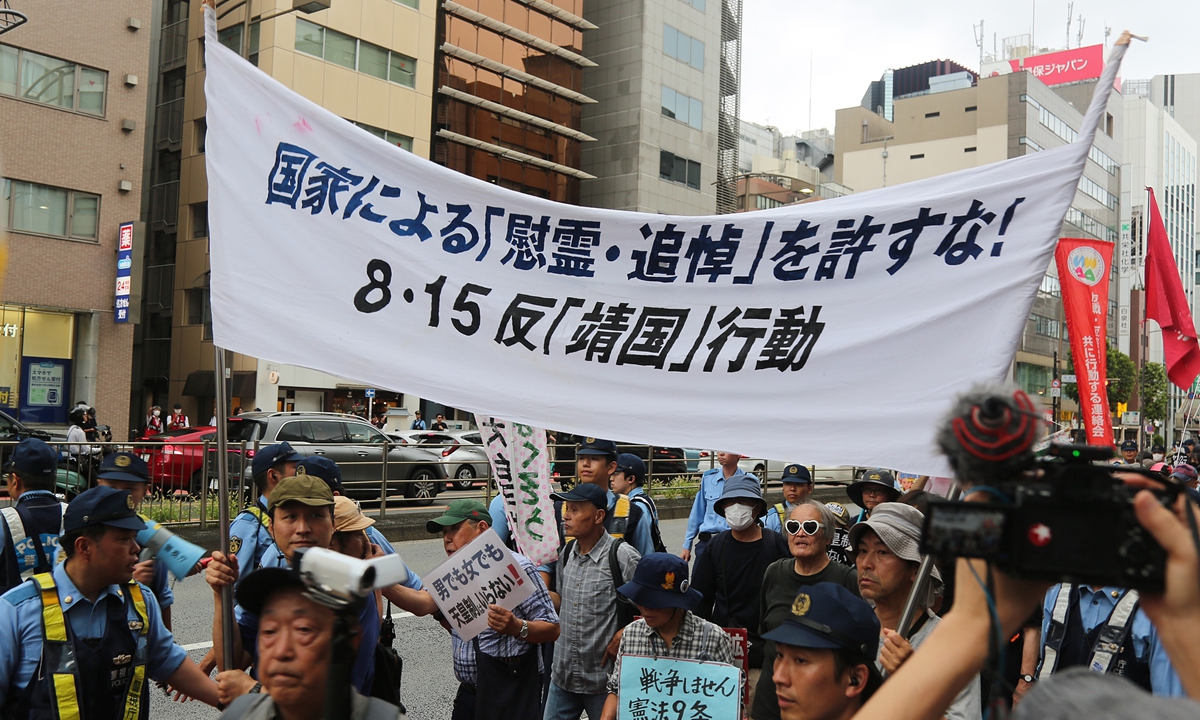
Against the backdrop of strong opposition from China and South Korea, another senior official from Japan's ruling Liberal Democratic Party (LDP) visited the notorious Yasukuni Shrine on Sunday, following a string of visits by senior party figures the previous day on the 81st anniversary of Japan's unconditional surrender in World War II.
Their handling of the Yasukuni Shrine issue, Chinese observers said, served as a revealing "mirror," laying bare the growing influence of far-right ideology in Japanese society and its gradual emergence into the mainstream to piece together the picture of neo-militarism, while broader political and security moves under the current government point to a gradual erosion of Japan's postwar pacifist constraints and a drift toward neo-militarism.
Rampant far-right sentiment
According to Japanese media outlet The Mainichi, Takayuki Kobayashi, a senior executive of Japan's ruling LDP, visited the war-linked Yasukuni shrine on Sunday.
One day before his visit, a total of four Cabinet ministers visited the shrine, along with three top ruling party executives - Secretary General Shunichi Suzuki, General Council Chair Haruko Arimura and election strategy chief Yasutoshi Nishimura, per the report.
Although Prime Minister Sanae Takaichi did not visit the shrine, she made a "tamagushi" ritual offering to the war-linked shrine in her capacity as president of the LDP. Takaichi also performed a remote act of worship toward the notorious Yasukuni Shrine, a symbol of the country's militarism and wartime aggression, from nearby instead of visiting in person, according to the Xinhua News Agency.
The shrine, located in central Tokyo's Chiyoda Ward, honors 14 convicted Class-A Japanese war criminals from World War II. For a long time, visits and ritual offerings made by Japanese officials to the controversial shrine have consistently sparked criticism and opposition both at home and abroad.
The visits drew immediate and firm opposition from China and South Korea on Saturday. China's Foreign Ministry, Ministry of National Defense and the Chinese Embassy have all voiced their objections.
"We urge the Japanese side to do serious soul-searching on its history of aggression, make a clean break with militarism, and earn trust from its Asian neighbors and the rest of the world with concrete actions," a Chinese Foreign Ministry spokesperson said in a statement on Saturday.
South Korea also denounced visits by Japanese officials and politicians, urging Japan's leaders to squarely face history and show remorse in order to develop bilateral relations based on mutual trust, South Korean media Yonhap News Agency reported on Saturday.
Kim Hak-jo, director general for international policy at South Korea's defense ministry, summoned Takeshi Nagayoshi, Japan's defense attache in Seoul, to the ministry headquarters and lodged a strong protest over Japanese Defense Minister Shinjiro Koizumi's visit to the shrine, the ministry said, per Yonhap.
Despite the criticism, Kobayashi said he visited the shrine as a "family member," noting that his grandfather had died in the war, according to the Mainichi.
Lü Chao, a professor at the Liaoning Academy of Social Sciences, told the Global Times on Sunday that Takaichi's move signaled "tolerance" of such visits. Even without visiting the shrine in person, Takaichi performed a ritualized act of worship toward it from nearby, which Lü said exposed her deeply entrenched position.
The episode also serves as a "mirror," laying bare the political attitudes of Japanese politicians and their views on war and history, Lü said. Looking at the visits by successive Japanese cabinets in past years, former prime minister Shigeru Ishiba at least expressed remorse over the war, whereas the current government has become more hardline. This shows that far-right sentiment in Japan is becoming increasingly widespread and is gradually moving into the mainstream, he continued.
"Japan is piecing together the picture of neo-militarism. The international community should remain alert to the risk of Japanese militarism's resurgence," the expert added.
Also on Saturday, Takaichi attended her first war memorial ceremony since taking office last year. In her speech, Takaichi pledged peace but she fell short of using the words employed at last year's memorial by her predecessor Ishiba, who vowed to keep in mind Japan's "remorse" over the war and expressed its "resolute pledge to renounce war," Japanese media Kyodo News reported.
Before the late Shinzo Abe, Takaichi's "political mentor," took office as prime minister for the second time in December 2012, Japanese leaders had consistently mentioned the nation's aggression and expressed remorse at the ceremony, per Kyodo News.
Takaichi's remarks seek to balance Japan's established national position with her own political interests and those of her party, Lian Degui, director of the Center for Japanese Studies at Shanghai International Studies University, told the Global Times on Sunday.
As a representative of the right wing in Japan, Takaichi herself does not advocate deeper reflection on Japan's wartime past, but she also faces constraints from opposing political forces at home. Her deliberate avoidance of terms such as "remorse" therefore reflects her personal political stance, while also serving as a compromise between competing forces on Japan's political spectrum, Lian added.
Takaichi has adopted similarly ambiguous language on other sensitive security issues. At memorial ceremonies in Hiroshima and Nagasaki earlier this month, Takaichi said Japan currently maintains its Three Non-Nuclear Principles but stopped short of explicitly committing her government to keeping all three principles in the future.
Lian added that offering ambiguous remarks could also be seen as a move designed to leave room for policy debates over possible revisions to national security documents and related principles by year end. "As long as right-wing forces remain in power, Japan will continue drifting toward neo-militarism through a gradual and sustained erosion of the constraints imposed by its pacifist Constitution," Lian said.
Underlying strategic anxiety
In Takaichi's speech on Saturday, she also claimed that her country could become "a shining beacon in the 'Indo-Pacific' that others could rely on." The Japan Times reported on Saturday that her inclusion of the term "Indo-Pacific" likewise brought her foreign-policy agenda into the memorial message.
In an effort to curry favor with Washington, Japan has sought to portray itself as a leading force in containing China's rise. Yet such ambitions clearly overstate Japan's own capabilities and amount to little more than strategic overreach, as the gap between Japan and China in terms of overall national strength remains substantial, the expert said.
Takaichi's decision to invoke its so-called "Indo-Pacific strategy" on a sensitive historical anniversary only further exposes her administration's strategic anxiety and uncertainty in the face of China's rise, Lian added.
。

B | 被告梅丽莎戴着价值1000元的金色LV手链离开路易威登门店。

C | (档案照片)不满丈夫进入奢侈品店只为自己买戒指,澳洲女游客试戴价值1000元的名牌手链后就离开门店,最后经理清算时发现库存有出入,保安人员查阅电眼画面揭发偷窃案。这起事件发生于2024年8月20日晚上10时左右,地点在滨海湾金沙的路易威登(简称LV)门店。

D | 来自澳大利亚的被告梅丽莎(48岁)承认一项偷窃罪名,被判坐牢五天。案情揭露,被告来新加坡旅游期间,入住滨海湾金沙酒店。

E | 事发当天,她与家人在滨海湾金沙逛街,进入LV门店时,被告的丈夫买了一枚戒指,促使被告心生嫉妒。被告随后试戴价值1000元的金色LV手链,逛了一会儿,就离开门店。

F | 门店经理在清算库存时,发现少了一条手链,将此事告诉保安人员,后者查看门店的电眼画面,才揭发被告的罪行,随之报警。事发后,手链物归原主。被告被还押至今,星期一(8月26日)早上通过视频会议出庭认罪,其间不断抽泣,用衣袖擦拭眼泪。

G | 律师代被告求情时说,被告患抑郁症,还在过去一年先后失去父亲和家公,目前仍处于悲伤之中。她原本来新加坡旅游,如今这趟旅行却成为最糟糕的噩梦,请求法官从轻发落。
Current article:http://te6ya8.shaihanhuangwoshang.cyou/zm6dw/afc4qur.html
Published on:22:30:30
 葵园筑彩梦,童心向未来——中关村一小顺义学校心理健康节活动
 美国制裁加码!韩国也快撑不住了,开始掉头转向中国?
 Shanghai Port leads world in green-methanol bunkering
 抖音购入手表存在质量问题走时不准,平台客服推诿不予处理售后
 Louisiana's Tiger Island wildfire ruled arson, officials say
 《政声直达》2026年8月17日
 队记:森林狼揭幕战对热火 需提速以抵消身高短板
 小花钱包放款当日扣权益卡钱诉求退还3170元代扣费用
 安布:建议米兰签德泽尔比,唯一要考虑的是他能否管理更衣室
 深圳龙华城管回应“暴雨天浇花”:给高架桥下的绿化带浇水
 Louvre Museum is being evacuated after a threat while France is under high alert
 郑钦文快来抄作业!27岁奥胖2-0横扫萨巴伦卡夺冠 3天连胜世界前2